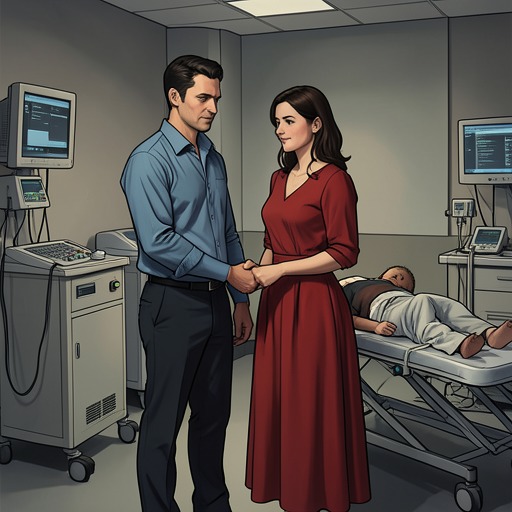
Angela Birdsey’s death
I Know This Much Is TrueAngela Birdsey’s death is a defining bereavement in Dominick Birdsey’s life: an ordinary morning’s delay brought him back to the house to kiss his infant daughter, where he discovered that she had died. The sudden loss ended the future he had imagined for his new family and remained vivid in his memories for years.
Background and discovery
Angela died in May 1983, three weeks and three days after her birth. The night before, Dominick had stayed up correcting his students’ term papers, intending to return them before the weekend. In the morning he overslept after turning off his alarm in his sleep. He was already halfway out the door when he decided to go back and kiss the baby, rather than risk being late.
Dessa had been up twice with Angela during the night and was sleeping in. Dominick had expected to get to know his daughter more fully once the school year ended: his spring included assistant coaching track, union work, and regular visits to Thomas. He pictured July and August as time for his wife and baby, a stretch of family life he could begin once those obligations eased.
When Dominick returned, he found Angela unresponsive in her bassinet. He understood that she was dead before he picked her up and tried to call for Dessa. The death was described as crib death; the account offers no further medical explanation.
The immediate aftermath
The loss left Dessa overwhelmed by grief. Dominick remembers her doubled over as the ambulance left their driveway, and later at the hospital, where the shock seemed to have diminished her. In the days that followed, he took charge of practical arrangements, dealing with the coroner and police while people brought food to the house. The casseroles accumulated uneaten; about a week later, he threw the food away, washed the dishes, and drove around returning them.
Dominick’s account sets this managerial role against the helplessness of the loss. Medical personnel, a priest called by Dessa’s family, and a hospital social worker took part in the aftermath, but their presence could not undo what had happened. The domestic tasks continued while neither parent could eat, giving the early grief a routine outward form without making it manageable.
Family bonds altered by the loss
Angela’s death also meant that Thomas never met his niece. After her birth, Dominick had visited Thomas and given him a cigar to mark the news that he was an uncle. Thomas had smiled, but Dominick and Dessa had not yet taken the baby to see him; they planned to make the drive that weekend. Angela died before the visit took place.
Years later, Dominick connects the separation from Thomas to the course of Thomas’s illness. He reflects that the illness ultimately separated the brothers in a way he had been trying to do throughout his life, while acknowledging that he sometimes desperately wanted his twin back. Angela’s brief life therefore enters the story not only as a lost child but as a missed meeting: the family connection was announced, celebrated, and then left unrealized.
Recurring grief and significance
In the seven years after Angela’s death, Dominick continued to relive the aftermath on sleepless nights. Her birthday and death day, and sometimes the holidays, brought back scenes from the ambulance departure and hospital. The memory returns in sharply particular circumstances rather than as a settled past, showing how the loss persists in his present recollection.
The event also exposes the distance between the future Dominick planned and the life that followed. He had postponed getting to know his daughter until work and other responsibilities subsided; the time he imagined with his new family never arrived. His memories preserve both the circumstances of the morning and the years of grief that followed, making Angela’s death a lasting measure of absence in his understanding of fatherhood and family.